Fix your Fitness Ritual
Category: Coaching Tips
By Jonathan Rai
Picture this common gym scenario.
You walk into the gym, drop your bag on the floor, and immediately bend down to touch your toes. You hold the position for 30 seconds. Then you grab your ankle behind you to stretch your quadriceps and hold that position too.
You repeat a few more stretches, feeling like you've officially checked the "warm-up" box.
Then you walk over to the squat rack, treadmill, or bench press and start your workout.
Within a few minutes, your body doesn't feel quite as ready as you expected. Your movements feel less smooth, and those first few sets feel harder than expected.
Sound familiar?
For years, static stretching—holding a muscle in a stretched position—was treated as the standard way to prepare for exercise. But exercise science has given us a more nuanced understanding.
The real question isn't:
"Is dynamic stretching better than static stretching?"
The better question is:
"When should you use each type of stretching?"
The answer can make your warm-up more effective, your workouts more comfortable, and your training routine more purposeful.
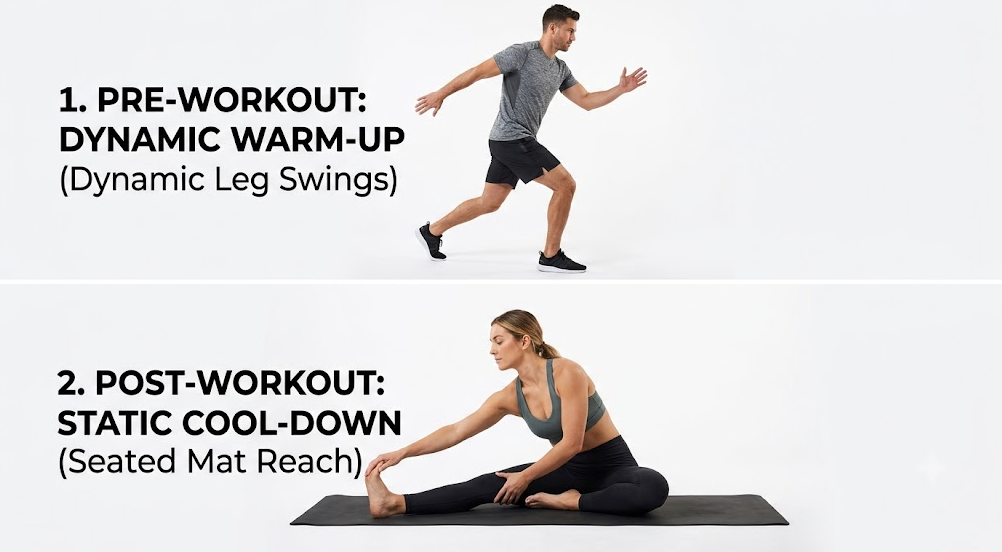
Dynamic vs. Static Stretching: What's the Difference?
Before changing your routine, it's important to understand what you're actually doing.
Dynamic Stretching
Dynamic stretching involves actively moving your muscles and joints through a controlled range of motion. Instead of holding a position, you continuously move through it.
Examples include:
- Leg swings
- Arm swings
- Walking lunges
- Bodyweight squats
- Hip circles
- Controlled torso rotations
The goal isn't to force yourself into the deepest possible stretch.The goal is to prepare your body for movement.
Static Stretching
Static stretching involves moving into a stretched position and holding it for a period of time.
Examples include:
- Touching toward your toes
- Standing quadriceps stretch
- Seated hamstring stretch
- Calf stretch
- Child's Pose
Neither type of stretching is inherently good or bad. They simply serve different purposes.
Why Long Static Stretching May Not Be Ideal Before Hard Training
If you perform prolonged, intense static stretches immediately before lifting heavy weights, sprinting, or jumping, you may temporarily change how your muscles and muscle-tendon units behave.
Research suggests that longer static stretching can produce small temporary reductions in strength and power, particularly when stretches are held for longer durations.
Static stretching is essentially a passive activity. Instead of repeatedly contracting a muscle, you move it into a stretched position and hold it there. With prolonged static stretching, muscle-tendon stiffness can temporarily decrease, while your tolerance to the stretching sensation can increase. This can make the muscle feel more relaxed and less tense.
That relaxing effect can be useful when your goal is to improve flexibility or wind down after exercise. However, immediately before a demanding workout, you generally want your muscles to be warm, activated, responsive, and ready to produce force.
That doesn't mean that every 20-second stretch will ruin your workout.
It means that duration and context matter.
A short, comfortable stretch incorporated into a complete warm-up is very different from spending several minutes aggressively stretching every major muscle group before attempting a heavy squat or sprint.
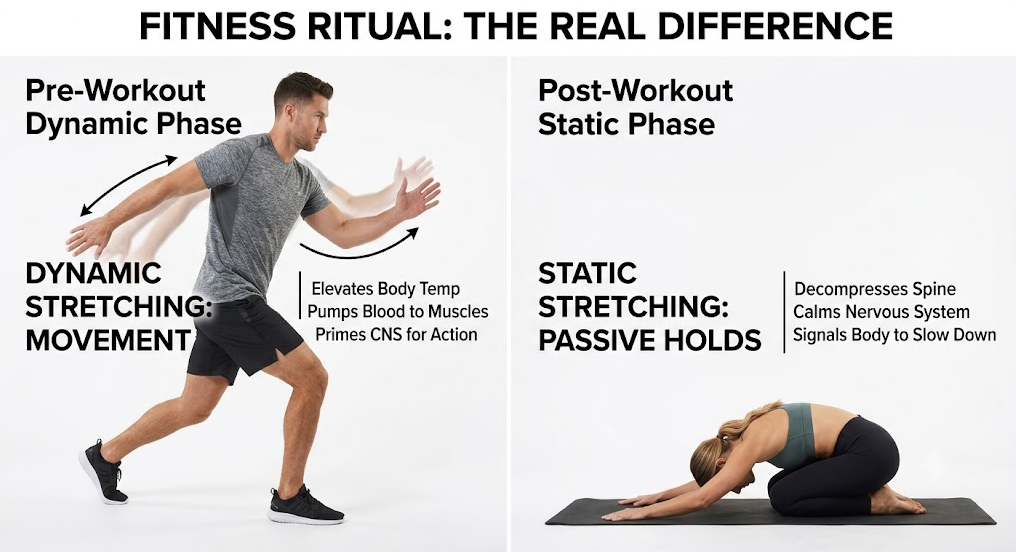
In simple terms, static stretching can help you relax and increase your range of motion, while a dynamic warm-up helps prepare your muscles and nervous system for movement and force production. The goal isn't to eliminate static stretching—it's to use it at the right time and for the right purpose.
Why Dynamic Stretching Works Well Before Exercise
Before training, your main goal should be to prepare your body for movement, not simply make your muscles feel stretched. A good warm-up gradually increases your body temperature, gets your joints moving, and prepares your nervous system for the movements you're about to perform.
Start with around 3–5 minutes of easy activity such as walking, cycling, jogging, or rowing. Then spend a few minutes on dynamic movements that match your workout. Arm swings can prepare the upper body, while leg swings, walking lunges, and bodyweight squats can prepare the hips and legs.
The final and often most important part is an exercise-specific warm-up. If you're going to squat heavy, don't go directly from a general warm-up to your working weight. Start with the empty bar or a light load and gradually increase the weight.
The same principle applies to bench press, deadlifts, overhead press, and other major exercises. Your warm-up should increasingly resemble the movement you're about to perform.
Where Static Stretching Fits
Static stretching still has an important place in fitness. If your goal is to improve or maintain flexibility, holding a comfortable stretch can be useful. It can also be a relaxing way to transition out of a workout.
After training, your muscles may feel tight and tense from repeated contractions and physical effort. Static stretching provides a gentle, passive stimulus that can help you feel less tense and more relaxed as you wind down from your workout. It can be a simple way to transition your body from an active state to a more relaxed state.
After training, you can spend a few minutes performing stretches such as Child's Pose, a seated hamstring stretch, or a gentle quadriceps stretch. As a practical starting point, hold each position for roughly 20–45 seconds and focus on relaxed breathing. You should feel gentle tension, not sharp pain.
You can also use static stretching at a separate time from your workout if flexibility is one of your specific goals. There is no rule saying that stretching must happen immediately before or after exercise. The important thing is to use static stretching for the purpose it serves best: **improving flexibility, reducing the feeling of tension, and helping you relax.
**
Can Stretching Prevent Injuries?
Stretching is often promoted as a way to prevent injuries, but the reality is more complicated.
Your injury risk depends on many factors, including:
- Training load
- Sudden increases in workload
- Strength
- Technique
- Fatigue
- Recovery
- Previous injuries
- Equipment
- Sport-specific demands
Stretching alone isn't a guarantee against injury.
A better approach is to prepare your body for the activity you're about to perform. Warm up progressively, use appropriate technique, manage your training volume, and give your body enough time to recover.
The Simple Rule to Remember
Think of your workout routine as Prepare → Perform → Recover.
Before your workout, raise your body temperature, move dynamically, and gradually practice the exercises you'll be performing. During your workout, focus on proper technique and appropriate progression. After your workout, allow your intensity to come down and use static stretching if it helps you maintain flexibility or simply feels good.
The biggest mistake is treating all stretching as the same thing. Dynamic stretching prepares you to move, while static stretching helps you work on flexibility. Neither is inherently good or bad—the key is knowing when each one makes sense.
So before your next workout, don't just stretch.
Warm up. Move. Practice. Then perform.
And when the workout is over, slow down, breathe, and recover.
That's a smarter fitness ritual.